I was once eating breakfast with a good friend of mine. At the time I was still in dentistry school and to impress him I shared my newly found knowledge of how our teeth are damaged from the acid in sour things we eat and drink. I believe the topic of conversation came from me not wanting to eat something I felt tasted a bit too sour for my liking. As I was explaining how the chemical process of acid on our calcium rich teeth works and feeling very knowledgeable, he looked at me with a challenging smile and asked: “How do you know?”
I was at the time less challenged by the question, than by the fact that he was completely unimpressed with my smartness. But as the years have gone, I have come back to this question in my mind many many times. How do you know?
How do you know what you know? Are you sure that you know? Who told you? Can you prove it for yourself?
I think in general we link the search for truth to a search for a higher meaning and purpose and having to do only with religion, when in reality it is connected to all things in life. Truth is something that touches everyone every day – whether we are looking for it or not. What you believe as truth whether it be scientifically, religiously, socially – the truth about yourself, about your neighbor, about the world – it all determines every single thought and action of your everyday life.
So how do we know what truth is? As Christians we go to the apparently obvious answer – the Word is the truth. The Bible is the truth. And sure – the truth will be found in the Bible if correctly interpreted. But how do you know that your interpretation is correct? Have you ever dared asking yourself that question? And why does it seem to be such an uncomfortable question all together?
Let me tell you a story of a visit I had to the US. I was in a bible school class Saturday morning, discussing the weekly lesson and our interpretation of a more or less challenging or difficult passage in the Bible, and a slightly tense atmosphere sometimes arises in situations like these. I did not notice it myself, but an elderly sensitive gentleman obviously felt it and had to react to it. His following comment made a great impression on me.
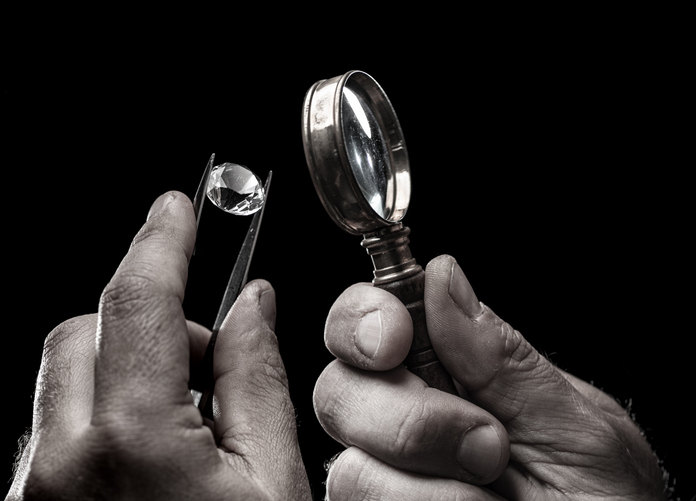
He explained that the truth is like a diamond. As individuals we may look and search and see only a small part of it, and we all look from different perspectives, because we are not the same in experience, personality, interests and so on. The diamond will look a bit different depending on from which side you look at it and how the light is reflected in it. The colors coming out visibly may seem a bit different when looking at one side compared to another, and the edges and corners of the diamond may seem to look different if you look from above instead of from the side – but it is still the same diamond. He was of course trying to bring unity and harmony instead of the tense atmosphere that had filled the room.
I like the analogy very much and have used it many times since, but it was lacking a very important and vital point. The most important question that should challenge us all is: how do you know that you are looking at the actual diamond? How do you know? Can you prove it to yourself?
If we transfer the analogy to the Bible, everyone looks at it from different perspectives, since we are not all the same. We are individuals. We come from different backgrounds, and what catches one eye, may not catch the attention of another one. The piece of the diamond that you have found and seen, is what you consider to be truth. But how do you know that what you have found, what you have interpreted, what you have understood is actually TRUTH? How do you know?
I have asked this question in another bible study group more recently, and it was not very well received. I am learning very slowly not to provoke for the sake of provocation, and this time it was not my intention to do so, but somehow, I still got carried away. I am also coming to learn and understand that human nature in general do not like to be questioned on what they know. It goes against our nature to be challenged and doubted, and it goes against our nature to realize there is a risk that we could be wrong. No one wants to be wrong. This is good. But our response to the realization that I could be wrong, is very inexpedient. It does not bring us forward but blocks us. Our response is however not a conscious choice we make, but rather a subconscious analysis with an almost non-existent reaction time and an almost immediate reaction, which we can hardly stop. And before we know it, we may say something that we later wish we never said.
Anyway – this time I forgot how not to be provocative, and I challenged every answer given to my question.
One answered: you shall know them on their fruits.
This was one of my favorites. And I asked him boldly and a bit too smart: Are you always holy? Obviously, from this situation you may have realized that I am not. I have a lot to learn. Does it mean though, that because my fruits are still pretty rotten, I have no chance of understanding the Bible correctly? I think the interpretation of this passage of the Bible needs a bit more thought than that. None of us would ever have the slightest chance to know and understand truth, if this is the case.
Another answered: we must compare passages of one part of the Bible with other parts of the Bible.
I asked him: then what about when we read passages from different parts of the bible and they seem to contradict each other? How do we choose which passage to put above the other one? Have you ever read in exodus that God hardened the heart of Pharao? Have you also read that Pharao hardened his heart? So, which is it?
Another popular answer I have heard many times is: If you are led by the Holy Spirit, you will come to the right conclusions.
Now, this may be my actual favorite and least favorite answer of all times. Least favorite because it brings all my unholy wrath to the surface. And maybe and hopefully you will soon understand why.
Since the Bible came into existence there have been many different interpretations of the Bible. If we look all over the world, the number of different Christian denominations is unknown to me, and we may never know the exact number if we include every small non-registered group in the counting as well. Besides that, each individual in each denomination may have his own opinion on one passage that differs from that of another one, even if they are in agreement on major theological points. However, looking back on the faith of our fathers and people who have given up their life on the stake for their beliefs and their faith in God, I do not necessarily agree with everything they believed back then. And even if I agreed with one of the fathers on everything, I would be in disagreement with another martyr from the past on something else since they did not agree on every point. You may ask yourself, if you do, and then next I would like to ask you:
Do you think you have more of the Holy Spirit than them? Do you believe you have more of the Holy Spirit than your neighbor in another denomination? If you do – what does that make you? A judge of the heart of your brother? Even just reading the last question again gives me the shivers.
I am not innocent in judging. No human being is. If he was, he would be in heaven, I am sure. But I would like that I should never consciously stay with any belief that makes me a judge of my brother whether he has the same beliefs as me or not.
An ever teachable spirit
I do not want you to think that I find the Holy Spirit irrelevant when it comes to searching for and understanding the truth – not at all. But I am convicted that the Holy Spirit leads, guides, rebukes and helps everyone – also those who have not come to conclusions like mine. I hope to come closer and closer to the truth every day myself. You see when I was younger, I was just as sincere. I was less knowledgeable, had less experience, understood almost nothing of what I understand today, but the Spirit of God was not less of a helper to me back then.
When I reached my twenties and came to understand a tiny bit more of the responsibility of being a Christian, I got very fearful and felt very small in comparison to this grand world with its supposedly older and wiser people in it. I was terrified of exactly the fact that these older and wiser Christians (compared to myself), never seemed to be in agreement. And I thought to myself – what am I going to do? Even the sincere Christian adults cannot agree on fundamental issues of our faith. Then how should I know?
Even after asking this question, years went by before I understood what I was missing. But as I decided that my entire life should be devoted to whatever task God had for me in this world, I made an agreement with Him:
Whatever you show me, I will pick it up. It does not matter if it goes against everything, I ever thought was true – whatever you show me, I will pick it up.
Until today I did. And I hope I will always stay faithful to this pact I made with my God. But since I like to challenge – without too much provocation – I would like to ask you: Are you willing to do the same?
A measurement of truth
I want a measurement that frees me of judging the individual, but helps me judge the information he lets out. I want a measurement that helps me see the truth, no matter how rotten I am – and even better – I want a measurement that helps me see and understand exactly how rotten I am, that I may have the possibility to correct myself and my wrong interpretation. I want a teachable spirit (God help me), and a measurement that will not allow me to stay with something incorrect, just because I have believed so for the past 30 years. I wish to never reach a state of unwillingness to challenge what I have learned, and test if it still holds water. I do not wish to believe anything because someone else has told me, but because I have proven things for myself and found it to stand up to scrutiny. And I want to never be afraid of the testimony of my brother that seem to contradict my own understanding, because what if someone else have found something vital and precious that I have not myself yet come to understand? What if God has a child out there just as favored as myself?
So, what is this measurement that we have all forgotten?
Now in order to judge if what you are looking at, is really a diamond, you must have a tool, a measurement – a reference. Something that can clearly show you, if you are looking at the actual diamond, or just something that looks very similar to the diamond of truth, but in reality is not.
When building a house, you need a building plan and a measurement. If you have only the building plan, but no measurement, your house will never stand, no matter how skilled the workers. To interpret and transfer the information from the building plan to real life, an objective, absolute, and unchangeable measurement is necessary. A folding rule. A spirit level. Something that does not change no matter from which side you look at it. The Bible is our building plan, but we are lacking a measurement – reference – something to compare our findings with, to test if they are true. A measurement like this exists, but it that has long been forgotten.
Now, God has mercifully built this measurement into everything we see around us. Everywhere in nature, He made sure that this measurement is accessible for every seeker of truth. This unchangeable and objective measurement is God’s Law of Life in nature – the law of cause and effect. Everything great and small in nature works by this same unchangeable and fundamental law, and only by this measurement can truth be found. Only by this law can you know what is possible and not. And the best part is, that it is not hidden to be only seen by the experts or the scholars. Our Father in Heaven has made it accessible to every layman sincerely seeking for answers in this time – the most darkened and confusing time in earth’s history so far.
With this measurement in our hands, and God’s Holy Spirit as our helper, we should have no fear of any information ever again, but we should rather investigate, scrutinize, and analyze everything we meet, to test if it is really the diamond we have found.
“Prove all things; hold fast that which is good.” 1 Thess 5,21
Skriv et svar